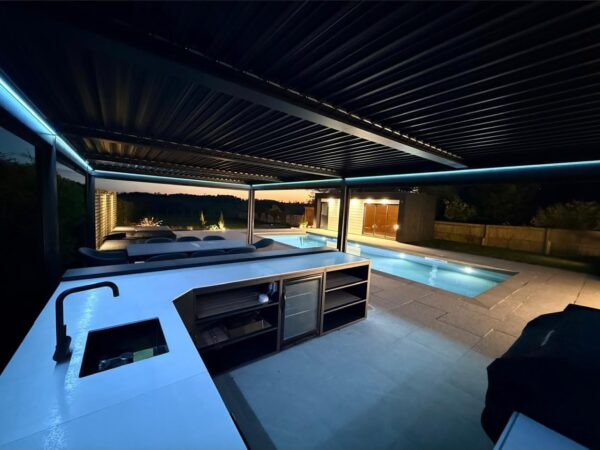
A pool is only as good as the garden around it

There is a version of this that goes wrong, and it is more common than you would think.

The pool goes in. It is a good pool, well built, properly engineered, and it will hold water for thirty years. Then the pool company packs up and drives away, and what is left is a beautiful rectangle of water surrounded by churned mud, a temporary path and a plant room nobody decided where to hide.

So you start again. New contractor, new survey, new quote, new mess. Except the levels are already fixed, the drainage runs are already in the ground, and half the decisions you would want to make about the terrace were quietly made for you months ago by somebody who was not thinking about them.

Swimming Pools

We do not work that way, because we are landscapers first.

When we design a pool, we are designing the garden at the same time. Where the terrace sits and how big it needs to be. Where the sun lands at six in the evening. How the levels step down from the house. Where the plant room goes so you never look at it. Where water goes when it rains, and where it goes when the pool backwashes. What gets planted for privacy, and how long it takes to grow.

One design. One team. One finished space – not a pool and then a problem.

Pools and Outdoor Water

Outdoor Pools

In-ground pools designed around your garden’s levels, aspect and access. From clean rectangular formats for proper lap swimming to shapes that follow the lines of the space.

Indoor Pools and Pool Houses

Enclosed pools and the buildings around them, where ventilation, humidity control and heating matter every bit as much as the water.

Spas, Hot Tubs and Water Features

Integrated spas, hot tub installations on proper bases with proper services, and water features that carry the same design language as the rest of the garden.

What happens before there is any water in it

Pool photographs all look much the same. Blue water, clean coping, nice furniture. What separates a pool that is still perfect in twenty years from one cracking and leaking in five is everything that happened before that photograph was taken.

Excavation and Ground Conditions

We dig out and assess what we find. Clay behaves differently from sand, and a high water table changes the design entirely. Where the ground needs additional work, we do it — rather than building on it and hoping.

Structure and Shell

The pool structure has to resist water pressure from the inside and ground pressure from the outside, and both change with the seasons. Reinforcement, thickness and waterproofing get specified for the actual ground on your site, not lifted from a standard drawing.

Plant, Pipework and Services

Circulation, filtration, heating and lighting are designed in before anything is buried, along with where the plant room goes and how you will reach it. All electrical work is certified.

The part other pool companies leave to somebody else

This is where twenty-six years of landscaping shows up.

Terraces and coping

The surface around a pool takes constant water, chemicals, sun and bare feet. Material choice matters and so does slip rating. We lay it on a full mortar bed with proper falls, so water runs away from the pool rather than back into it.

Levels, steps and retaining

Pools nearly always need a change of level somewhere. Retaining walls near a pool carry loads that ordinary garden walls do not, and they need designing accordingly rather than building by eye.

Drainage

A pool surround sheds a great deal of water. It needs somewhere to go that is not your lawn, your house, or the pool.

Planting and screening

For privacy, for shelter from wind, and so that the pool sits in a garden rather than in a clearing.

Lighting

In the water, around the terrace and through the planting. It is what makes the space usable after dark, and it is usually the thing people remember.

How a pool project runs

01 Site visit and feasibility

We look at access, ground conditions, levels, services and where the water table sits. Some gardens take a pool easily. Some need significant groundworks first. Some genuinely are not suitable, and we will tell you that early rather than late.

02 Design

Pool and garden designed together — position, size, shape, depth, surround, planting, lighting and plant room. You will see plans and visuals before anything is committed.

03 Permissions and compliance

We will advise on whether planning permission is needed, and handle Building Regulations and electrical certification.

04 Itemised quote and programme

Costed by element, with a realistic programme. Pools take longer than people expect, and we would rather set that expectation at the start than apologise for it later.

05 Build

Excavation, structure, services, water testing, surround, landscaping and commissioning.

06 Handover

We will show you how everything works — water treatment, circulation, heating, covers, winterising — and leave you written instructions in plain English rather than a carrier bag of manufacturers’ manuals.

Why bring a landscaper into a pool project

  • We think about the whole garden. Pool specialists design pools. We design the space that has a pool in it.
  • Twenty-six years of groundwork. Excavation, levels, drainage and retaining are the hardest part of any pool project, and they are what we have been doing all along.
  • One team, one point of contact. No gap between the pool contractor and whoever comes afterwards to sort the mess out.
  • We finish the job. The garden gets handed back finished, not as a hole in the ground surrounded by ruts.

Common Questions

For an outdoor pool with reasonable access, typically twelve to twenty weeks from breaking ground to swimming, depending on size, ground conditions and what is happening in the wider garden. Indoor pools and pool houses take longer because there is a building involved.

An outdoor pool in a rear garden usually falls under permitted development, but there are plenty of exceptions: listed buildings, conservation areas, land in front of the house, and anything involving a building or enclosure. Pool houses and enclosures very often do need permission. We check this at feasibility stage rather than assuming.

Outdoor pools cost less to build and are used for perhaps four or five months a year in this country. Indoor pools cost considerably more, both to build and to run, and get used all year. Neither is the right answer for everybody it depends how much you will genuinely swim.

Heating is the largest cost by a distance, and it is almost entirely determined by whether you use a cover. An uncovered outdoor pool loses most of its heat overnight through evaporation. A good automatic cover pays for itself in running costs, which is why we specify one on nearly every project.

Yes, and sloping gardens often produce a better result. A pool set into a terrace with a retaining wall behind it looks deliberate in a way a pool dropped into a flat lawn does not. It costs more, because retaining and groundworks cost more.

More than the pool itself. You need circulation space around it, somewhere for the plant room and somewhere to sit. We work the whole layout up at design stage so you can see exactly what is left before anything is dug.

Usually, though it changes the method and the price. Where a machine cannot get through, the work becomes slower and more of it is done by hand. We will tell you at the site visit what the access means in practical terms.

Water testing and chemical balancing, filter cleaning, and seasonal opening and winterising. It is a weekly job rather than a daily one, and it is entirely manageable once somebody has shown you how. We do that at handover.

Yes. Tired liners, failed finishes, dated shapes and inadequate plant are all fixable, and renovation is often the sensible option where the structure is sound. We will tell you honestly if it is not.

Start with a site visit

Every pool project starts with somebody standing in the garden working out whether it is possible, what it involves and roughly what it will cost. That visit is free and there is no obligation attached to it.